
Harold Whiting: A Remembrance
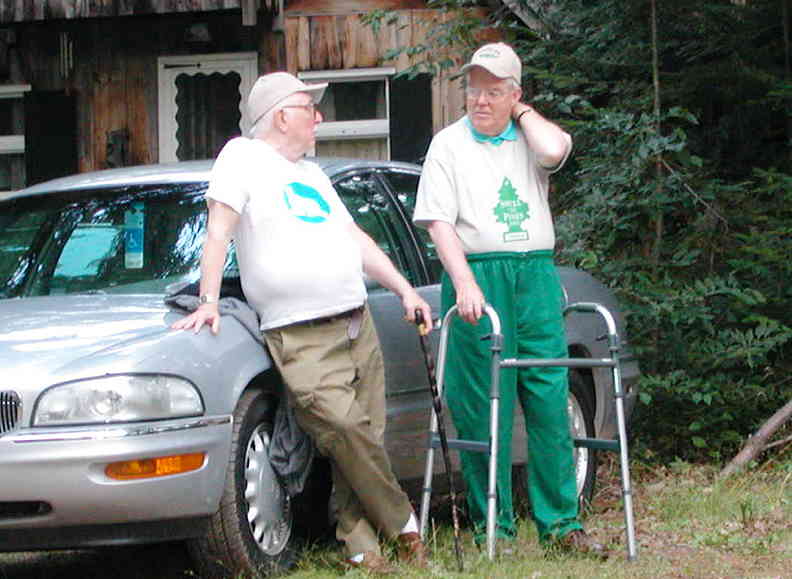
We are closing in on the 50th anniversary of Camp Kirkham. Through decades of effort by many we are secure, efficient, even relaxed in its operation. It is difficult to comprehend what it took to start the undertaking, and that is why we owe a debt of gratitude to Harold Whiting and the men of his times.
Harold joined the Troop in 1963 with his son, Wally (’52), and quickly became an essential member of an inner circle of staff ** that dramatically moved Troop 25 on the path we are today. Harry’s vision was to have a Troop camp exclusively for and run by itself. This was far different from our Council camping experience at the Lake of Isles, yet a plan was put into action. Moving our operation to the other side of the lake meant having our own equipment, being mobile and doing something unprecedented.
Harold took on the title and expanding responsibilities of Troop Business Manager. With the other key Staff they sought out what would be needed: Tentage for patrols, seniors, staff, dining, kitchen, headquarters, storage. stoves, kitchen supplies, trays, silverware, tables, refrigeration, bunks, boats, generator (the only electricity) etc. etc. All of these with the mantra of getting it free or cheaply. Harold related to me stories of what creative and resourceful ways it took to search and track down all of these items necessary for a large Troop. It all had to be transported to our new camping site, intensely set up and in two weeks intensely taken down and transported back to Manchester. This was accomplished by the generous use of trucks from Harold’s Oil Business. There was so much more gear than Center Church could store. Through Harold’s network of friends the rest was stored in empty business spaces all over town.
This was not a one-time operation but was done for the succeeding six years.
During the yearly camping trips, Harold would carry in his large Ford station wagon supplies and scouts (at that time, as there were no rules of all needing seat belts, thus as many people as would fit were crammed in.) He also worked out a very unique plan with a local meat packing plant. The Troop would buy what was anticipated to be needed for the year, the packing plant would store it, and before each trip Harold would request the types and amounts, pick up the order and deliver it to the trip. Walking into Whiting Oil on Broad Street, a collection of Troop materials were always close by as he would devote time to troop business there. He had metal address plates made for Troop mailings that saved from doing all by hand.
We currently are secure in knowing the results of owning our own Camp, however the process gaining it is good to note. Once decided (around 1968), this Central Staff group led by Harry sought out, researched and site visited a number of possibilities. Land for sale at Dodge Pond became the choice, but for a cost that would need an outside loan. Banks evidently are not keen on loans to breakaway scout troops attempting to do something no others have. The solution could possibly come from our sponsor– Center Church. Our ties with the church were very strong and many of its elected officials were also on the Troop staff. Harold, as did others, served as Church Moderator, leading the Church to approve securing a loan for the land purchase (banks, evidently are not fond of loaning to churches, as the possibility foreclosing becomes awkward– and thus to gain this was good fortune.)
It was very often left to the Troop Business Manager to process the paperwork related to land purchase, development, insurance, loan payments, filing of forms etc. etc. as ‘call Harold’ was a continual phrase. He was a charter officer of the Camp Kirkham Corporation. Once operational in East Lempster, Harold used his Troop role to seek and establish essential local contacts and resources for development. Generous support was gained by his efforts with building stores, supermarkets, machinery owners and a most accommodating Road Agent– also named Harold Whiting. These critical first years were aided by his expertise in problem solving and ‘behind the scenes’ efforts that hardly were noticed by the rest of us. Within that time frame Harold’s sons Wally (52), George (54) and David (57) became Eagle Scouts.
As the decades progressed and many of these original ‘Founding Fathers’ passed into our history, Harold continued a strong interest in Troop affairs, to visit camp and partake of social gatherings despite health issues. Until recently, our cardboard posted signs on camp property still contained the wordings that in case of problems ‘contact Harold Whiting, Troop Business Manager.’
In recent times we would visit him and be fascinated as pieces of Troop history would be unfolded. He faced a number of health issues, yet was clear and sharp with a positive attitude on what had been accomplished. I did once pose to him, being in awe of the aggregate volunteer time and efforts, how so many chose to do so much (feeling possibly when faced with those challenges today, we might not take them on). He thought momentarily and then rather, as if it was a natural normal course of events, said ‘Harry would put out a call to get things done, and we would all offer rather eagerly to do it.’ May that continue to be a legacy of Troop 25. For his wife, Doris, and his family we are grateful for Harold’s contributions and wish them the best.
** Harry Maidment, John Bowen, Dick Knight, Murray Johnston, Norm Chatel.
0 comments