
Appreciate from Whence We Came
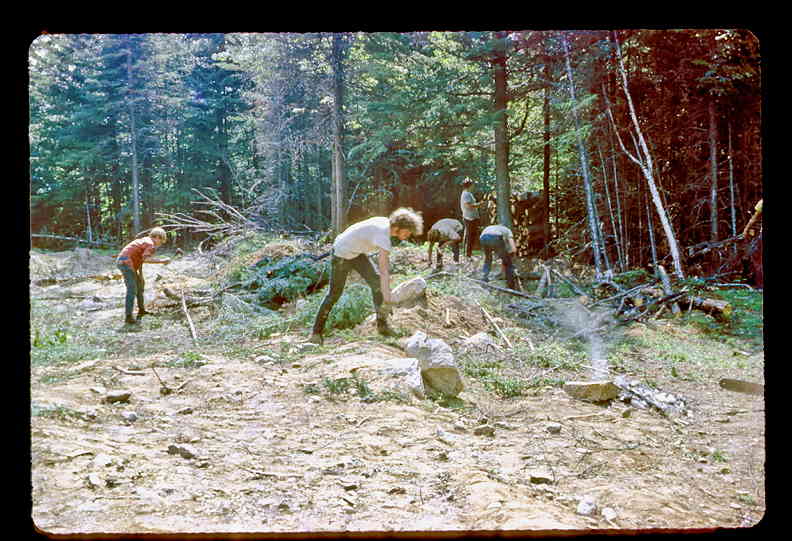
Duane Mitchell tells the younger scouts in the Troop– ‘If you have heard of the Woodstock Musical Festival, when it was going on, my age group were the first ones building Camp Kirkham.’ A message from that Woodstock was to ‘get back to the land,’ and rather directly Troop 25 chose to leave the comfort of the civilized council camp, to carve out of the New Hampshire woods our Camp of 47 years. Before that, had been camping experience at Camp Pioneer, then Lake of Isles. I imagine Camp Kirkham has eclipsed both of them in time and number of scouts.
Looking at the present camp, it seems close to the familiar look it has always been. It might be good to reflect how it began. The 1952’s found a thickly wooded acreage– cleared a parade ground, road to dining, and the boy scout area, and a waterfront, burned wood and brush continuously — all during the two weeks the rest of the Troop was having summer camp at Lake of Isles.
Keeping priority of importance– the two LT’s were the first structures to go up.
We all came for the first time in 1970. The 1953’s opened the show as JA’s, and the 1959’s began the run of scouts only knowing Kirkham as their Summer Camp. From the Kitchen Tent, quickly came the Kitchen building– although without the additions to the side and back. Silverware had been donated for use– much of it stamped with ‘Sterling Silver’ on it, and we had no fewer than four metal hand cranked meat grinders. In the rear there was an area that had a café style booth to be relaxed at. It was a gathering place for staff at night, and John Ostrout made it his mission to paint it yearly as his contribution to maintenance. Built on the back of the Kitchen was the supply room. There were building supplies scattered about. When you have a volunteer staff eager to help, there can be zealous buying duplication. Harry once added up the ‘square’ nail boxes bought and claimed we could rebuild Keene with them. It was the sole building to be really dry from the rain, have good lighting and able to keep things in.
To the left of the front kitchen stairs was the cement ‘Ye Old Well’. It was originally the cement structure that Ken Uppling painted a large ‘Peace Sign’ in brown paint, which Harry, not tolerant of such, had re-captioned. As scouts lined up for getting food from the kitchen windows, they paralleled the dozen large metal trash barrels. While convenient for coming out of a meal and throwing away trash, they could tend to smell in the August heat and have the chorus of hornets around them. (one of the most satisfying and favorite job given to me was taking the ‘Garbage Run’ — using Harold Whiting’s black historic pickup truck, senior scouts hanging on the running boards or standing in back– on a ride down Route 10 to the Landfill. This might also result in a return stop at the Chatterbox for soda and candy.)
In the back woods, we had made a Nature Field, and have kept it cleared every four years through Forestry merit badge. The Beaver Pond nearby had enough water to float a canoe in (which had to be used to reel in some senior Night Orienteering hikers.)
Next to the Kitchen, backed up against the forest front, were the two huge canvas mess tents, resting on dozens of grey wooden platforms. They took the entire camp to set up, and take down. Inside a row of bare light bulbs were strung across the crest of the tents. That lit the green wooden tables and wooden folding chairs that Center Church gave (as they updated theirs).
In the proximity of the front of the Mess Tents was the Nurse’s wall tent. As time went on, in that area was a platform that the open Leather Craft picnic table was set on. There was no Staff Cabin, Staff Area, ‘Geriatric Area’, Health Lodge or Craft Building in this area– just the remaining pole like fur trees that would later be nicely replaced by the Christmas Tree like Spruce. There was, however, a silver metal sign post– on which Murray Johnston had brightly painted signs as to the direction of the Kitchen, Parade Ground, and Waterfront.
Moving into the Parade Ground, this multi-use area held the usual Retreat Ceremonies, but also was the only ball field and parking lot. A flag-pole was erected and statically placed in a hole. (after digging it out a few times, having ‘all available Staff report to the Parade Ground’ to help lower it, to untangle the tangle– it was improved by the pin and brace structure used today. Cleverly, the top of the pole was decorated by a small painted globe (which on close inspection was a toilet bowl float– as budgets were tight then.)
The Kirkham plaque was made and needed a location. George Caron (of East Lempster), willing to help, rescued a stone monument from a building being taken down, and used his ‘cherry picker’ to set it in its current place. Plaque and stone were covered with a green tarp for the unveiling ceremonies at the 1971 Camp Kirkham Dedication.
The Gateway had the newly carved Camp Kirkham sign by Frank Krawshaw (who had been active in the early 1950’s, and spent an entire camp chiseling with precision to make it.) Harry’s vision was to have his camp emulate Camp Pioneer as he remembered it– so, excess staff were put to work making log towers on either side of the road to place the sign on top of. These towers tended to rot and need regular replacement, until the effort exceeded the effect and current simple telephone poles became the easier structures. Camp cars lined both sides of the sign, scattered wherever they could get off the camp road without becoming impaled on rocks. Our road seems still primitive, yet it is the result of a number of re-grading’s and improvements. If you don’t like it now, you should have driven it in its first incarnation. We had attractive signs on Route 10 showing the way to us– until they ‘went missing’. Should you ever be driving by and see one hanging inside a garage, please let us know.
Heading down the path to the Boy Scout area, on the left at the curve was the JA Tent. John Bowen wisely decided near the end of the decade to move it farther back in the woods. In the spirit of ‘do as I say, not as I do’, each night the scouts, who had been meticulously judged in daily inspection, walked past the ‘Ghetto Tent’ on the way to retreat and peered at the hovel conditions the junior staff lived in. In believing the behaviors would not change, we moved the tent. The pathway down had every staff engineer try to solve the erosion problem that washed it out regularly. There was no Boat House, but for a number of years we had the Bunk House. This was a former metal walk in cooler building painted green, donated by the Gess Family, that was filled with bunks and waterfront equipment.
The Pyramidal tents in the Boy Scout area, sat on eight grey platform sections linked together by locking blocks and leveled on cement blocks. Surrounding each tent were raised railings that put to use the countless pole tree trunks that forested the camp area. The tent ropes were tied off on them and considering their total amount, replacing them when the stress broke them became a regular job. It was a time of six or seven patrols instead of the current four.
At the end of the Patrol area, on the right, was the sloping rise that served as the first Amphitheatre. It is now a Patrol cooking area, but was the site of campfires and Courts of Honor before we owned the land to make the current one. (When the new Amphitheatre was being developed, it was first thought to make it emulate the one made at Lake of Isles by the Troop Staff, with inlaid terraced wooden seats of telephone poles. I remember John Bowen explaining that keeping the beauty of the natural land setting would be best, as each year the pines would rain their old needles to a new cushion to sit on.)
The Waterfront was condensed. We did not yet own where the row-boats are now, so they were on the left side of the dock. There were only 6 rowboats, 6 aluminum canoes and 5 sailfish for the fleet, thus with larger numbers of scouts, they had to be well scheduled. The dock sections rested on wooden supports that were difficult to adjust into the changing pond water levels faced with each year. Next to the dock was a hastily made rickety lifeguard tower, on which the field phone hung. We had somewhere been given a small homemade wooden cabinet with a small shingled roof, that for years served as a place to store leftover soap. Resting there was our version of a battle trophy– the waterfront horn, that generations enjoyed pumping out loud sound, and had been the pride of the Lake of Isles Sailing Base until liberated and brought north forever. The canoe racks and buddy board were made of local trees that were replaced on a four-year cycle when Pioneering was the merit badge.
Socially, there were more Ladies in camp– Ester Maidment, Dorothy Bowen, Lois Beckwith, Karen Newman, Barbara Joyner– helping with the kitchen, served the nursing function and added a dimension not recently seen. In the later evenings, the staff seemed to have three social options. Many were Veterans of World War II and would be found on the porch of the Kitchen at night. The newly constructed Bowen’s Cabin was the nightly place for the Scoutmaster to hold court with a selection of invited Staff. John and Dorothy Bowen were certainly key at this time in every aspect of the camp, and were gracious hosts in their living room at night or their back porch in the afternoons. The third choice was to ‘take to the road’ to search out local hotspots such as Mr. G’s or Peter Christians.
In 1974, the folks on maintenance hollowed out the woods area behind the mess-tents, set up three wall tents, and cemented in the first staff fireplace (which, for years, you could see the initials in the cement of such as S. (Steve) Hale.) This new area was designed on the logic that, given a good place to be, the staff would remain nightly home, rather than risk dangers in public. That summer, Paul Kudra, in serving as Waterfront Director, used his mornings off to create the premier four hole golf course, thus ensuring staff enjoyment throughout the days and evenings.
Staff housing kept changing. The Bowens had select people stay with them. Gary Peters and I had a double bunk in 1970 inside what became their bathroom. Harry set up his camper trailer next to the Kitchen, which I first shared with Gary Peters (now of Australia). An odd and welcome invention came into our grasp– the Hot Comb. This was the male precursor of a portable hair dryer, which ran off an extension cord to the Kitchen. It became less about grooming, but outstanding for throwing out heated air– like having an inside campfire on cold mornings and nights. Next year the trailer was shared with John Ostrout and my portable record player. The first year was the incessant playing of ‘the Candy Man’ by Sammy Davis, and the next summer was the continuous non-stop of ‘Joy to the World’ by Three Dog Night. Scouts were serenaded by that tune at every breakfast, whether welcomed or not. The Cooks must have had a wall tent near the Kitchen, and other tents for those dropping in for the odd few days.
Harold Whiting had a trailer for himself at the edge of the Parade Ground. As the Business Manager, he made the initial contacts with so many of the services and individuals we would count on. We were tabula-rasa moving our operation to a new area in a foreign state. We needed so much local help that he gained for us. We were also willing to give the help. Having a new camp drew large numbers of staff, and while needed at critical times, could be a nuisance having them just hanging around. Harry’s solution, by diplomacy, was to offer to have them paint our new home-town of East Lempster. The town sparkled and we began to build needed rapport for those to watch over the camp the time we weren’t there. We had been the benefactors of help by the town Road Agent– Harold Whiting. (the Troop proudly had its own Harold Whiting as Business Manager).
The daughter of Harold (of N.H.) became ill, and upon hearing of it, the Staff collected and donated money to help her. I believe there was a happy ending for her, and that kind of good-will seemed to separate us positively from other ‘flat-landers.’
A Camp Corporation was set up in a fashion of Bolton’s Camp Johnson. This was to insure that the national organization could not claim it (as they had been selling off other of their properties to gain cash, regardless of the history of service). By the time the final Saturday came, we had been breaking the camp down for three days previous. Harry was regaining the voice he lost during the second week from yelling. Families ran the gauntlet with their cars as they drove in, picked up footlockers, then went back down the road as far as the person preceding them had parked (being Lake of Isles all over again). There were large trucks, borrowed from benefactors, coming in to be loaded for home. Separate crews and returning seniors met at the Church to unload and carry tents, boats, tables, chairs and thousands of other items across Woodruff Hall and into the Pit.
The Staff worked until darkness, then set up on the, now empty, mess tent platforms for the traditional feasting of steamers and chicken. Even after two weeks of leading in every capacity, Harry, as does Paul, had the energy to lead in hours of song and entertainment. The next morning work continued until 2pm. At that point came the Lobster and Steak and the gradual dis-engaging from the area. There was no council camp ranger to check us out, oddly there was only one building to secure and we were all ceremoniously and deservedly fired by the Scoutmaster.
In touring the camp today, we have a greatly expanded set of buildings and facilities, and have changed the land from a wall of small pole fur trees to a nicely mixed forest. It has evolved steadily and aged well due to the efforts of those in over four decades. It astounds me that a single troop could have such a place, for yearly use of two summer weeks, and two later weekends.
Harry proudly, and arrogantly declared ‘the law of the land ends at our gateway’ proclaiming we had a kingdom of our own design and run with a spirit we made. Realizing that has had to be modified with time, for those of us seeing it from the start– there is value in remembering how great the effort was to begin this. Those first years, as it had been at the end of Lake of Isles, meant shipping from and to Manchester almost everything each year. It took huge amounts of volunteers much longer than today. What remained in East Lempster were the stacked bunks in the Kitchen, space made so efficient you had to walk sideways to get in. Otherwise all boats, tents, patrol boxes– thousands of items were carried home to be stored until the next summer. There was no return for a Father and Son Weekend, nor a Ski Trip. For all this work, Harold Whiting said there was an enormous enthusiastic volunteering of time and resources by those in the center of it and extending out far to many others. Compared to the last years at Lake of Isles, it was less to do– as being our own camp, the platforms could stay in place. It should astound us all for what had to be done and has continued for almost 50 years (looking forward to the next reason for a major Party)– but the overriding point is that then, and now– it is OURS. In it resides the memories and experiences of generations growing up, a place you can always feel welcome returning to, and one that has the future to be gained.
0 comments