
I Just Happened to be There
Troop 25 for the decade 1961 to 1971
In 1961,
Roger Maris was yet to hit his 61 homeruns,
Yuri Gagarin had recently been the first human in space to orbit the earth,
John Kennedy had been President for a few months,
And with the 1950 age group, I joined Troop Twenty-five.
A year earlier the Boy Scouts celebrated their 50th Anniversary, which I had noted by reading Boys’ Life then. During the May Court of Honor—in Woodruff Hall (where our regular meetings are now) the Tenderfoot Ceremony was held. We were blindfolded with the black and red Troop 25 neckerchief. The exact ‘Tenderfoot Log’ we still use today had the three candles lit on top as symbols of the Scout Oath, with the bottom twelve for each quality of the Scout Law. For weeks previous we had met to prepare us. I had been in Cub Scouts (Packs 153 and 53), earned Weblos and felt ready to move forward. We were given a copy of the Scout Hand-book, personally inscribed by Harry.
Patrol
I was placed in the Moose Patrol (that animal chosen because it had been a nickname of Harry in his earlier scouting.) Age-groups at that time came in with over twenty members. They were divided among 8 Patrols. I believe Wolf was the first in Troop history, along with Sequoia and Panther of today. The others were Fox, Apache, Lion and Eagle. Everyone in their first year was a ‘rookie’ and that title identified you in situations throughout the year.
Wednesday night meetings were held alternately as a Patrol Meeting (at your Patrol Leader’s house, then the next week a Troop Meeting at Woodruff Hall.) Patrol Meetings were led by JA’s and worked on specific skills and badges, and a Staff person would drive the circuit to take attendance and monitor our progress. There was always the emphasis on first-aid, but also learning Morse Code, Compass and Map and making a ‘Horseshoe’ for your pack.
Twice monthly we were pulled together for Troop Meetings— and had to wear uniforms. This practice was changed in 1964, as all Wednesday meetings would be uniform Troop meetings, which led to consistency and much easier supervision. There was a game period before that included ‘Steal the Bacon,’ and a game where a JA stood in the center and swept a rope around the floor in a broad circle. A boxing glove was at the rope’s end, and scouts (standing at the edge of the circle) would have to time a jump as it came around. If the rope caught you, it wrapped your legs in it and you became intimately close to the wooden floor.
We always had Opening—a rotating Patrol bringing the flags, leading in the Pledge of Allegiance, and giving a simple vignette linked to something we were doing. Uniform Inspection followed. Periodically handed out at the end was a mimeographed sheet that outlined what was the schedule for the next month. The meeting ended with all standing and Harry leading us in the Scoutmaster’s Benediction. Right hand on the heart, left hand extended straight out for ‘May the Great Scout Master of All Good Scouts be with Us Till We Meet Again’ (with the rising of emphasis and volume on the last few words.)
In October, a highlight as it is now, was the Halloween Party. The Costume Parade, Dunking for Apples, Donut on a String, Onion Roll and Pie Eating Contest have consistently been entertaining. The game of Truth or Consequences rarely had the contestants get the ‘truth’ part, thus served a rather disagreeable ‘consequence.’ At the end, donuts and cider were enjoyed by all. The First-Aid-Oree tested skills learned the previous months to arrive with the Patrol worthy to represent the Troop at the district competition. During Scout Week, the Pot Luck Supper and following Court of Honor brought families together in Woodruff Hall. We held the May Court of Honor that graduated the Junior Assistants into being alumni and staff, and moved everyone else up on the seniority ladder.
I remember before joining, my Mother pointed out an article in the Manchester Herald and commented ‘Troop 25 wins just about everything.’ First Aid-O-Rees, Camporees, Scout Shows at the Armory—the Troop was more involved in district and council events—and seemed to be the great favorite to take first place.
When the 1960s decade began, Harry, as had been the case, was the truly energetic, focused leader that initiated and produced almost all of what we did. Enter the first Associate Scoutmaster—Norm Chatel, who became a dependable partner in Leadership. As the decade progressed we gained the group best described as the ‘Founding Fathers’ (Dick Knight, Harold Whiting, Murray Johnston, John Bowen, John Bengston, Herb Joyner, Fran Aldrich). There had always been good participation of Parents in specific roles, yet this group chose to be consistently active in meetings and trips. They formed a tight knit central ‘cabinet’ with expertise’s that complemented each other and allowed Harry to step back for a more macro view. This would become essential and a strong reason for the vision that led to having our own Troop Camp.
Center Church
It is very fortunate that Center Church has been consistently the home of Troop 25. Woodruff Hall and Memorial Hall are scenes of our Wednesday meetings. The Sanctuary for Courts of Honor, and Memorial Services. The use of the kitchen for events. The Pit, where our equipment is cared for and stored. The Scout Room for planning and keeping our materials (should you come back decades later, the Scout Room will refreshingly appear as you remembered it.) We have enjoyed the support of its Ministers, Church Staff and Congregation.
Of the times I write about, Center Church had an extended reach to us. Belonging to it was a pre-requisite for membership to the Troop. It provided new age-groups of over 20 normally, thus making our total number over 100. I found that it meant some of my neighborhood and school friends could not join, but later understood better what this connection of Church and Troop meant. The key element was that the Junior Fellowship Leader of the Church was also your Scoutmaster. This insured your participation in both.
Only as an adult, did I realize other troops had differing timings for their camping trips. They might head out on Saturday morning and return late Sunday afternoon. Our tradition was to arrive Friday night, and be pretty well out early Sunday mornings. What drove this, especially for Practice Camporees, was to have scouts up, packed, judged and on the way home—so that on arriving you could drop your gear, change to respectable clean clothes—to make it to the Sunday Youth Church Service—because your Scoutmaster, now in his role as Youth Leader, was standing at the door taking the expected attendance.
One of our fall Camping trips was a Religious Retreat to Camp Asto-Wamah. Wednesday night was Scouts, and Tuesday night was Junior Fellowship (with a dinner preceding). Being within the Congregational denomination, as a Senior Scout the three-year process of the God and Country Award was guided. This meant a number of service hours to the Church (one of my personal disappointments was not gaining this award). All of this served to unify and strengthen the ties we had with each other through Religion and Scouting. There was a duality that meant that Troop Families were also Church Families. A significant number of parents holding leadership positions in scouts, also held positions of leadership at Center Church.
Of benefit to us was the Waterfront Property at Bolton Lake that was owned by Center Church. For a short drive from Manchester, to the narrow lake roads, to their parking lot—then walk down the dirt pathway to the double lot with swimming area, picnic area and changing building. Troop families would be often be there for a common social time that further linked us to scouting and church. This was the time that Harry initiated the full Red Cross Program for us at Summer Camp. It upped our game in water safety and led to older Senior Scouts gaining certification for Senior Red Cross Lifesaving. Thus, Troop 25 took over the concession for lifeguarding at the ‘Church Property.’ A number of us served that role, in a place we had grown up enjoying— and gainfully now employed.
Manchester High School
Belonging to a Manchester Troop and Church meant almost all families lived in town and went to the Manchester Schools. When in my first Troop years, I would find it strange for me to see High School age Senior Scouts in groups in town hanging around each other. I still had my friend groups separated—with the Scout friends when doing Scouts, but outside of that with others. When at the High School, my realization came that my primary friends were now from the Troop. It became an understanding of what I failed to earlier see—that the activities done as a Senior Scout—Ski Trip, Camp, Appalachian Trail, Canoe trip, Bermuda—melded a friendship with those of the common experience that you did not get sitting next to someone in study hall or as part of another club.
The most significant aspect here is that once at Manchester High School, your Scoutmaster also became your Guidance Counselor. No matter where your last name fell on the guidance assignment list— Harry ensured you were transferred to him. Imagine the power that held, as he could access your poor grades or discipline issues at any time—and was not shy to bring his judgment to your attention.
You became accustomed, if not fearful, of him jacking you loudly out of a study hall or grabbing your hair in the hallway and escorting you to his office. Keeping track of ‘all my Children’ was a service provided free of charge and the upside meant that when you did get over your head with problems, he was the trusted one you sought out for help. Paul continued this role, a bit milder, as a career French Teacher at MHS.
Summer Camp
Harry Maidment’s reference points on what a camp should be, directly related to his experiences from the legendary Camp Pioneer on Westhill Pond in New Hartford. It had become closed for summer camping and we were in the second season of the new Council Camp of Lake of Isles (outside of Norwich and now a Mashantucket Resort). Schools at the time did not start until after Labor Day. This meant the dates for camp were later than now. There was also the effect of the Pratt and Whitney ‘Shut Down’ that may have contributed to the timing also.
When arriving you noticed that the long road in had been oiled to keep the dust down, which provided a smell only found there. There was no bus, as presently is. Since the drive was shorter, families came to drop us off. This meant all day Sunday was a parade of relatives coming to view the sights, and to Harry’s chagrin many overstayed and thus were in the way of his progress.
Harry was the first Scoutmaster in the Council to attend Summer Camp with his Troop. As a Council Camp, our troop was under the leadership of their staff (which he did not like), on their camp schedule (which he did not like), and in their ‘units’ (which he did not like).
We were assigned to Camp Apache (Pioneer, Rockledge, Cedar Hill units) which placed us a considerable distance from the dining hall, parade ground and waterfront. I remember spending so much time walking—for breakfast and back, to the waterfront and back (classes were in the rather colder morning there), to retreat and dinner and back, and often for a night program and back.
Retreat was held with other troops in the large parade ground. At the timing for the flags to be taken down, the command given of ‘hand salute’ a small canon fired off a loud bang that, although predictable, still startled us. David Maidment has continued the firing at Camp Kirkham.
The Dining Hall was large and we waited outside for our large troop to get its time to eat breakfast and dinner. Each patrol chose a ‘waiter’ from amongst them that brought butter, milk and such to the table and cleaned and swept up after the others were dismissed.
Many of our activities had been carried over from Camp Pioneer and continue today (Ghost Hike, Officers in the Lake, Moby Dick, Wrestling Night, Campfires.) We also had Boxing Night with huge pillow gloves. I got into the ring once (with Brian Rogers), remember getting knocked down but ending the match in the customary ‘draw’. The highlight was always Walter Prowa—who had taken lessons in the sport. We sometimes invited troop 47 to our activities (Harry had ties to its Scoutmaster Bob Von Deck), and it seemed there was always someone foolish enough from their troop to box with Walter and gave us amusement to watch the punishment given as we cheered for our troop.
There was a trading post where we could buy things like candy and ice-cream, and that took only cash. This meant we had to take care of our own money throughout. That meant, in my second year, that having the cash pooled together, the Moose Patrol impulsively bough a puppy being sold during camp by the nature center. We named it Duffy (after Duffy Brookes, our JA.), we fed it well, gave it plenty of attention, took it on a leash with us whenever possible and had it sleep in our tent. On the last retreat of camp, we had my father hold it on the sidelines, and it barked through the entire ceremony. As we had not thought the plan through past camp, and since our parents did not share the enthusiasm for anyone taking it home, Duffy (the dog) was given to a friend by Duffy (the JA)—and I believe having a patrol pet at camp was never replicated.
Inspection might have been very similar to later years were it not for the ‘help’ given by very young Paul Maidment and very, very young David Maidment. Along with Esther, they stayed in the Family Area away from our camping. However, the Inspectors must have thought them cute and brought them along. It seemed that just as our Patrol was looking good, the younger of the brothers would scamper underneath the tent platform to find (or I still suspect—planted) papers, that when he came to the surface with a smirk, knocked our results down.
The end of camp brought two fund raisers. We were each given the Tom Wat Kit, the contents of which had small gifts/ wrapping paper/cards. We were instructed in the good points of each item and sent off for a number of weeks to sell to all. There were incentives for those raising the most money—I was pleased to get a transistor radio one year– that I smuggled onto camping trips for a number of years. Just before school began, our first Candy Sale took place, where we wore our white Troop sweatshirts, got a pre made route list and went door to door.
Camping Trips
Should you place a camping schedule from half a century ago next to a current one, they would mirror each other in intent and purpose, but different locales.
Campfires
The contrast between the surrounding darkness and the bright towers of flame, the single voice projecting ‘WE……..’ (like the baton of a symphony conductor focusing us, and the pause for a moment so that we can all respond in unison) ‘……….Are the Scouts of 25 You’ve Heard So Much About……’. If you have gone through the Troop, this image needs no explanation. From the beginning to the snap off at the end ‘HOORAY,’ and silence to hear the resulting echo across Dodge Pond. Harry gave credit to a previous Scoutmaster for penning it, and distinctly good to know it is ‘our song’ in every sense.
Our campfires are a relatively simple activity in our current times. They are enjoyed for being social rather than individual, for you feel a member of something larger. They can be done in any season, outdoors or in, and be a patrol activity or larger troop one. They can include a story, a legend of the Honor Society, a visit from Santa Claus, a reflection of AT or Canoe and expectations for what is coming next.
Musical accompaniment – Harry’s preference was the ukulele, combined with special performances with his accordion. Paul and Mark prefer the guitar. Interspersed within the decades were musically inclined, talented senior scouts and staff that branched us out and enhanced the repertoire. The choice of songs often maximizes audience participation, highlight heroes and villains and reflect on history.
Raised to a higher level– campfires exemplify the ‘progression’ of the troop experience. Upon joining, you sit cautiously, looking around and finding the older scouts are enthusiastically singing with confidence and seem to know so much of what you know little. There appears no delineation of age, as the adults and scouts equally join in. You pay attention, looking to snatch a piece of the chorus so you can feel a part. In the next years you move from memorizing chorus, to verses, to judging what are the favorites you look most forward to. Of course, all your friends are now singing with the same surety.
As you near the end of your seven years, should you look to see the new scouts, and remember that you were once in their shoes, there comes the realization that in this progression you have not only learned the songs, enjoyed the campfires, but that you serve as the positive model for the new scouts entering, in their hope that they might get to where you are. The simple analogy of the songs can expand to so many areas of skills and values that one gains and projects to others in our Troop 25 process.
Paul has guided new recruits to sing before officially entering. Mark has given us a troop specific songbook. Should we be able to compare the current line-up side by side with one of decades ago, we would find a high amount of similarity (we do seem to have a penchant for songs of the sea that end tragically). Should you be away from the troop for any length of time, you can easily again step back into the times of your youth through a campfire. It is significant to watch alumni fathers sitting with their troop sons sharing what both have come to know. Of note to me at the current campfires is to realize (with our sustained participation) that I am usually singing with a number of the same folks I was twenty-five to fifty years ago. I know of no other organizations that have that active reach.
It is the campfires that connect the current scouts with the great number of troop generations in decades before. ‘The Scouts Of 25 Are On The Way—HOORAY.’
Father & Son
While Camp Pioneer was no longer used in the summer, it provided us with the Father and Son and two Winter Camps each year. In the early autumn its long grass parade ground gave enough room for the long line of Father’s cars, and the long line of Pyramidal Tents we stayed in as Scouts. At this time, many of the Fathers had served in World War II. What this gave them in common was a set of experiences in their later teens far different than being at a scout camp.
Distinct to this trip was the aroma in the crisp air of simmering sassafras tea. Sassafras seedlings appeared plentiful (their leaf shaped like green mittens), and Harry knew how to take the cleaned roots, place them in water filled metal pans, and wait for the roots to turn it to an amber color liquid. It had a unique flavor and the warmth felt good on cold afternoons. The stoves this cooked on had burners resembling those of today, however the fuel that was used was white gasoline (which added an air of danger each time used.) They had a red gas tank that needed to be pressurized by pumping the lever on the side. I was a bit envious as a scout to find such an effective way to have a fire without needing to go through the process of getting wood and so on from there.
We had classes throughout the day, and it appeared to include for older senior scouts a game of football against the Fathers. There were Patrol Campfires at night, visited by the traveling Minstrels. Jumping way ahead, this trip was changed to Camp Kirkham, although in the first years the purpose was different. Fathers were encouraged to attend— for their skills and expertise in helping with needed work projects. The connection between Father and Sons came second to the needs of improving our new camp.
We finally reached that point to where the focus would be on activities that would be nicely shared with scouts and their adults. We sometimes use central cooking to cut down on the time needed for preparing all meals with patrols, in favor of more time for program activities. There was a realization that this trip allowed us to showcase what we do for the fathers, considering the bus brings the scouts to camp in August, and when they are picked up at the end, the camp has been all but taken down.
Religious Retreat
In October we traveled to Camp Asto-Wamah in Colombia for a Retreat weekend. It was a time of reflection, discussion and contemplation and was led by Harry and Reverend Simpson. We were used to primitive settings the rest of the year, but this camp had modern cabins with bunks and comfortable mattresses. It provided a further link with Center Church, and help with the God and Country Award. As the Troop diversified from towns lived in and religions, this trip changed to a theme based camping in such places as Goodwin Forest and White Memorial Forest.
A part of each camping trip was the Vesper Service. It had that beautiful outdoor setting, a repertoire of Vesper Songs, and a lesson from Harry that was inspirationally linked to the qualities of scouting. Later Fran Aldrich created our portable Worship Service. This is a marvel to unfold and find how it fits together. Harry related that our portable Organ was a donation from the Kirkham Family. Harry had seen one during World War II and Ed Kirkham had tracked one down. Both have traveled with us since.
The Hike
When I was eleven years old, the distance from Center Church to Camp Johnson seemed much longer. Once hiking away from Center Street, going to Bolton was quite rural with little traffic. In comparison, today’s staff is challenged to inventively design routes to stay as much away from traffic and development as possible.
It was the hike that introduced us to the Legend of Squaw’s Cave, the Notch Railroad Tunnel, and the Bolton Cider Mill. It brought us into the house of this expert woodcarver who amazed us with what he did. It stuck so much in my mind that he could turn a single wood block into a wooden chain with movable, interlocking links. He made it into ‘Ripley’s Believe it or Not’ with his talent. We looked forward to the break for lunch and take out and consume the variety of food carried. Today we hike on the Rail Trail. We previously hiked on the actual Railroad Tracks—and in my first year the adventure was increased when a train actually came that scattered us to the side. That year I also cut my leg on old barbed wire as we bushwhacked across a field, and had to be bandaged later by Norm Chatel. It was always a satisfying conclusion to walk down through Camp Johnson, to hot cocoa in the cabin, and to know we weren’t like the oft rumors of the poor Patrol lost somewhere between there and Rhode Island with the State Police called in to search for them.
When the scouts have left, Camp Johnson provides the tradition for the Patrol Leaders Dinner. They meet to do group building activities, then (for years thanks to Jeff Bissell) get served shrimp cocktail, then char-broiled steak and baked potato, completed with pie.
Winter Camps
Although we were also at Camp Pioneer in December and February, the scene was so very different from the Father and Son. It was a dark ride on Friday night, west on route 44 to New Hartford. Then up the hills to the camp (which the winter could make treacherous to get there, or go home Sunday.) Arriving meant carrying your gear into Frontier Cabin (which you knew from its location and the wooden sign above the door.) Harry would then assign your Patrol either to Pine Tree, Hillside or Birch for Scouts (first year Seniors stayed at Frontier.) Older Seniors were ‘Cabin Leaders,’ and often took ‘green boxes’ with them that held the materials they would be teaching classes with the next day. Through the doorway of your cabin was the large room with bunks lining the sides for sleeping, and a large center table with benches for eating. At the end was a large wood burning stone fireplace. Beyond was a smaller room with sink and stoves serving as the kitchen. The most coveted of all—was to see if you would be lucky enough to sleep in the loft next to the chimney (where you could look down on the rest, and spy on the leaders.)
The next morning was breakfast—Oatmeal was a Winter Camp staple, and the best was when it included apple slices and walnuts. After, the cabin turned into a classroom, where Patrols rotated on schedule to learn such as Bandaging, Flint and Steel (fire-starting), and Splinting (First Aid).
One of the mornings, our Patrol came upon a Troop that was camping on this frigid weekend on the ground in pup tents. Our curiosity led to us being invited inside by two scouts to see their situation. Both had on all the clothes they brought and were inside their sleeping bags, and still looking very uncomfortably cold. They told us they had not slept due to the cold night, had not thought it a good idea to venture outside their bags to either start a fire, or cook breakfast. Their plan was to remain until told they could go home. Our Troop, at the time, seemed to have the arrogance of being really tough—but we had to give this one to that troop. We also became very, very appreciative of our style of winter camping in comparison.
There was the good break for lunch –and a time for the Cabin Leader to mix the cake batter, pour into the shallow long metal pans and put it into the wood fueled oven in each cabin. This was challenging to do well—it was years later at the Freeman Farm at Sturbridge Village that Paul Maidment and I heard the correct techniques the early settlers needed to do so that their cakes (like ours often) did not end with one side burnt black and the other side still dough. Cabin Leaders were really given a good leadership experience. They were ‘El Jefe’ within this self-contained weekend empire.
Afternoons continued the classes and might see us going across the street to Westhill Pond for ice activities. I was fascinated by the boathouse Camp Pioneer had, as it had the shape and looks of a ship docked next to shore. It is fortunately still there and in use. If the snow cover was adequate, we would go behind Birch cabin, where the land sloped downward for long toboggan runs. This was not without danger, as it went through the forest trees. Jeff Metheny has worn well the burden of piloting the toboggan that broke Harry’s arm when it crashed. Our Scoutmaster seemed to have no regrets from it. There was a cabin at the edge of camp called ‘Hessians’ that had a connection to German soldiers in the War for Independence. As much as I was drawn to find it, it always seemed too far and never seen by me. Certainly, another distinct smaller building was Cabin 5. This was where the most Senior Staff stayed and used as their planning station. It was the kind of place that legends were made from.
During the day you could smell the smoke from the cabin chimneys, and the sound of the chain saw used to supply the needed wood. Dinner and cleanup took place in your cabin, then an interesting scene took place. In the dark of night you could see dozens of flashlights emerging from the surrounding cabins, their lights waving randomly across the snow—and all making their way to converge at the central destination of Frontier. When going in, we were told to take off our coats (the reason to insure we would not sweat inside, then freeze going back). We crammed this rather large group into the main room to find bunk space to sit (if you were on the bottom bunk, you could expect to see the feet of the person above dangling down in front of you.) Since cabin fireplaces had been going from the time arriving the previous night, it was beginning to be a comfortable temperature, even somewhat warming the cement floors. In December was our Holiday Party with songs of the season and a visit from St. Nick. In February it was an enthusiastic campfire. Dessert was from the cabin cakes, and considering the conditions to bake them there was a considerable variety of their outcomes. The condition of your piece, like spinning a roulette wheel, was based on luck of the draw.
As we went into the 1970s, the Troop gained the fortunate use of the ‘Buckskin Lodge’ that provided a much larger improved space for entire Troop gatherings. Some of my most favorite Holiday Party/Campfires came from there.
Winter camping was not a comfortable way at times. The LTs were outside, the snow could be deep, at times there was more smoke inside the cabins than out. Communication between cabins was done by military ‘Field Phones’. A spool of wire was unrolled to connect to the phones in the cabins. To call, you had to crank the side lever then press the lever on the phone receiver and hoped someone at the other end responded. As time went on, the camp could not sustain its quality and you might often find a broken window pane next to where you were sleeping. Eventually for all the tradition and history, it was sold to become a housing development.
Of significant note for us at Camp Kirkham, when one stands in front of our headquarters cabin—you know it is ‘Frontier’ because of its location, and because of the same exact wooden sign above the door, that I looked up and saw at Camp Pioneer over 50 years ago. Well done to the 1960’s that went on the recovery mission to save it, and added a good continuing piece to our legend. For those that lived it, I have found in talking about Camp Pioneer with them, that the glass is always more than half full, that the times there were unique and not replicated.
It was a special camp.
It has been our good fortune to have a number of decades at the 4H Camp Ragged Hill Woods now. This gives an exceptionally comfortable large space for the entire Troop, and a large camp area to provide our activities and keep our traditions continuing.
Camporees
Spring brought the Camporee season. Two Practice Troop Camporees and the District Competition. These focused on the Patrol to hike in, choose a site, set up and improve it. Preparation for them meant each person was given a green canvas tent half. When buttoned together with another half, it created your Pup Tent shelter. If you were in your third year, you got to carry all in a large Rucksack that had an external metal frame. For the rest, packs of the time were smaller and needed creative ways to bring what was necessary—which the ‘horseshoe’ was implemented. It began by laying flat your tent half, placing your sleeping bag flat on top of it, folding in the tent end flaps over it, getting your Patrol mates to help roll it lengthways, keeping it as tight as possible, then tying with twine that gave it the look of a long green cigar. It was then bent around and fastened with twine on your pack, giving it a horseshoe shape. It meant your sleeping bag was waterproofed inside the tent. This looked neater when done on Wednesday meetings at the Church, compared with doing the process with cold hands for packing out on Sunday. Your Patrol decided on a menu, which the times then were starting to offer dehydrated foods (like Tang) that were lighter to carry.
Your campsite was to be expanded in its makeup as if you planned to be there two months rather than two days. Canvas tarp went up first (in case of rain), then pup tents and supply tent. We were preoccupied with digging holes, with a collapsible shovel. The Garbage hole was two feet diameter, circular and the depth of the shovel (extended) used for digging. We burned paper trash but crushed metal cans and such for garbage. The LT was a narrow trench the width of the shovel blade and deep. A ‘refrigerator’ hole was lined with wet moss to hopefully keep it cool. Glacial till and tree roots underneath and unseen made the digging more difficult. We chose a location for having the fire and moved rocks in place to surround it. We needed to prove that we could harvest firewood to the extent that, were trees to disappear completely, we would be able to survive for a long while on what we had at hand. Water had to be found and brought back in our plastic lined water backpack, and more for the canvas fire-bucket.
A Chopping Area was set apart, as hatchets were part of our issued equipment. To make this all look ‘tidy’, all ground cover was taken away from the central tent and fire area, and we made cleared pathways to the holes, chopping area and other pathways. We lined the paths with wooden poles found. We put an upper and lower fencing of twine around the chopping block and holes, then placed aluminum foil strips in between, so that they would reflect our flashlights at night and keep anyone from falling in. We were now ready to fashion a wooden table using twine and construct a number of conveniences such as pack hangers on trees, paper towel rack, posted a schedule and menu inside a clear plastic bag and tied to a tree, and created a utensil rack. We always put out a canvas washbasin with soap next to it (although I don’t recall anyone ever using it). A creative attempt at humor was to hang a frying pan from a tree and a sign saying ‘Judge Alarm’. We cooked Patrol meals, went to classes or field day and were judged.
In breaking camp, we scattered the mound of unused firewood, kicked leaves back over the pathways and camp area, dropped the fireplace rocks in different places, put the soaked fire ashes into the garbage hole. In filling in the once proud hole achievements, you had to insure that you mounded them over with dirt (to allow for settling), and know that judges were prone to poking at the first few inches of soil to cite you for not digging it deep enough or producing too much waste.
Camp Johnson was our earliest trip, and we hiked up their narrow road from the gate to the top. There were abandoned cars poking out of the woods for a long time, in my imagination the results of racing and crashing there. At the top we alternated by going to the left of the pond, or right into the woodlands to find our spots. The Cabin provided shelter from rain and cold and the fireplace for Saturday Troop Campfires. In reflecting, Camp Johnson opened in 1950 and for the next quarter century had yearly 6 to 8 Patrols from Troop 25 camping there, on top of all the other troops using it. Thus, the chance progressively diminished that you could dig the required holes without bringing up a previous set of garbage, or worse. It became afterwards a minimalist camping scheme that placed all into marked sites, used permanent fireplaces and no holes to be dug, (garbage carried out and outhouses used.)
The long reach of the Troop extended into many areas. Harry relished getting prime steaks from Ben Zollo at his Market for the Staff on Camporees. Coventry Camp was the property of Steve Loyzim. He was a quiet Gentleman that let us use his land, in the wise practice of us burning the fallen wood slag yearly (without burning down his land in the process). There was a stream that provided generations with catching of cray-fish, and the Skungamaug Golf Course moved next to it. It was the trip that Daylight Savings Time began on and evolved into a ‘Survival Cooking’ plan that featured no pot-utensil-less cooking like ‘egg in an orange’ or Hunter’s Stew in foil. One year in the mid-1970s Mr. Loyzim visited us as we camped, bringing each scout an ice-cream on Saturday afternoon. When we arrived home the next day, we found he had passed away on Sunday.
The District Camporee was held at a different site each year that was kept a secret. The fear was that Patrols, knowing the location, would sneak in ahead of time, find the best spot and begin setting up. Our Scouts did a number of stealth missions and bent rules with impunity, yet the idea of making more work for ourselves ahead of time if we found the location never crossed our radar. We did find that the scouts competing against us had less equipment and stood in straighter lines with carved walking sticks. If Boy’s Life was a measure, they were moving towards being like it, while we were comfortable moving in the opposite direction. These Camporees lasted until late in the afternoon on Sundays and took a very long time for the awards to be tabulated because of the sheer numbers of patrols. It seems that the District Camporee format has not been followed for many years, thus making how we train and how we camp experiences just within our Troop.
Somewhere between Honor and Mercenary
I had a curious career with District Camporees. My second year in Moose Patrol sent us to a Camporee that rained from the start onward. Once dry in our tents, for the rest of the time, we saw diminishing returns in the notion of going outside to improve anything in the campsite. The Judges certainly noted this in their scoring. It was decided at some point that this Camporee was a ‘wash-out’ and Patrols were notified that they could begin to break their campsites. Moose Patrol now sprung forth and energized with prospects of leaving for drier homes, packed up our minimalist effort and were ready to leave. With much sarcasm, we were told after that while we had placed very last in the camping competition, we had managed to be first out of the wet woods. For us it was a sense of perspective as to what defined ‘accomplishment’. They did give all of us a nice plastic neckerchief slide, which oddly is the only one I have worn since 1963.
The next year saw a drastic change. Feeling our Troop was under-performing, it was decided that the Patrol to come in first in Troop 25 for the District Camporee would win a prize– a trip to the New York World’s Fair of 1964. This transcended any importance of beating other troops and focused our efforts completely on winning the Trip. We worked continuously start to end, then stood with all the others as the scores were read in descending order. We mentally checked off each Troop Patrol as the places were announced and lustily cheered and jumped when realizing we were the only ones left standing. We were looked at strangely by others, as the winner of the District Camporee was yet to be announced. They had their notion of accomplishment, and Moose Patrol had theirs, meaning again a matter of perspective. Patrol Leader Paul Frankenberg did have the good presence of mind to go out when we were called, the rest of us still obliviously celebrating our Troop victory. We actually came in second in the entire District– missing out by one point. We found out we qualified to compete in the higher rung of the Council Camporee, and in our arrogant euphoria decided to continue our conquering.
There appeared not much history of Troop 25 in a Council Camporee. I remember it being held at Lake of Isles and that we felt foreign among the strangers there. We came out with a Blue Ribbon, but felt, again, that their version of camping differed from what we were used to. We certainly enjoyed the day at the World’s Fair, with Harry driving us and being the perfect guide for it.
Good fortune continued for Paul and I as the Troop expanded the prize notion to include Senior Scouts that we had graduated into. Crew VIII saw the good sense to have a day at the World’s Fair, worked towards it and beat the Troop competition. At the ceremony, being Crew Leader, I was called out for us being third place for the District, then the judges hesitated, conferenced and realized they had transposed the top three spots– thus we actually won the District Senior Camporee. We shared another great trip to New York with Harry and the (conquering again) Moose Patrol.
The World’s Fair closed the next year, but not the eye on the prize, as the new incentive was a Major League Ballgame at Yankee Stadium. Before cable TV, options for watching were limited, radio meant using your imagination following the commentary and this gave us, most for the first time, to see the big leagues in person– if we could win. It seems safe to notice that desire to compete declines as senior scouts get older. What we had going for us was the rather laid back, relaxing mode of the other crews. They measured the prize against effort needed to be expended and chose to, by all means, let us solely labor intensely. Our veteran crew raced to victory in the Troop, and second place for the District. We had discussed among us, that we might like having a go at the Council Camporee if we placed first in the District– but with second place we shrugged it off.
A week later Harry called me into his Guidance Office at MHS, chortled (which he could do well) and said a mistake had been made and that we had actually won the entire show. Our main enjoyment came from the trip, in Harry’s Green Truck, to the legendary Yankee Stadium to watch them play the Baltimore Orioles. We were in awe looking at everything going on around us, seeing for the first time these Major League Stars– in real life. Ever conscious of a bargain, and probably a result of not being an astute sports fan, Harry got us tickets in the upper part of the first base side– sitting well under the overhang. Thus we could see the field and any ball hit two feet in the air. After that the overhang kept us guessing, by the actions of the players, where the ball would eventually come down. I remember Curt Blefary hit a three run homer (we know that because we saw him circling the bases) and the Orioles used it to win. It was a great triumph for us to sit in the stands, soaking in the Yankee history and knowing we had won the Troop Prize again. I was also pleased that later, as their JA, Dan Kimball’s Sequoia Patrol won the entire District Camporee.
Spring Trips
It is a noble effort to plan and produce a Troop Camping Trip from start to completion. Add involving new Recruits, large numbers of Fathers and automobiles, and a rotating set of multiple destinations and that describes our plan for Spring Trips. It was Harry’s vision that wanted the scope to provide us visiting places beyond the realm of school trips or family vacations. In going through his files, it showed the amount of correspondence written to various places, their subsequent replies and the resulting course to be taken. Often found after six years in-between were the times a place was no longer around, thus needing to adjust the plan in a new direction. Trips at this time still went far away, but without the benefit of subsequent Interstate Highways to travel on. Each trip needed the leader to ‘Bird Dog’ it to gain specific trustable directions for all (this was long before technology so helpful today.) For so many of us, this was the first Troop trip taken (quite possibly the first real camping trip), provided a showcase to Father drivers for us at our best and kept, through this rotation, the freshness of never having the same trip more than once during your scout experience. The Duke of York reminded me that, frugal of our budget, our lunches were peanut butter and jelly sandwiches put together Friday nights by the new first year seniors. We wore our uniforms to give a good public image and it was the trip that began the tenure of Patrol Leaders, JAs and bumped all up to the next stage. At that time the trips were: West Point, Freedomland (one time), Boston, Cooperstown, Ticonderoga, Plimoth/Edaville Railroad, New Jersey (once), East Bridgewater (once), Burlington (once).
Senior Scouts
When explaining the success of the Troop, Harry with pride, would focus on his development of our Senior Scout Program. ‘We hold our kids, and the others don’t’ was a solid reasoning. By design, trading being a ‘Boy Scout’ for a ‘Senior Scout’ meant you had really made it in a number of direct and subtle ways. At Camp your tents were located in a different area, as were your position at Retreat. You could project that attitude of superiority to the younger ones. Inspections might be more relaxed and Senior Taps was later. You learned how to sail—the first craft operating on a power other than your own. Being at Camp Apache, Lake of Isles, meant you had to row or canoe across the lake to their sailing base. Combine that with the time needed for the return trip, and your thoughts of spending the afternoon skimming across the water on a sailfish with the wind were quite curtailed. This also brought out the nature of a council camp. By the time Troop 25 arrived near the end of the camping season, these fine craft had been in weeks of use and showed the wear, sometimes broken parts that diminished what a sailfish could be capable of.
There was the Dance—held in the Apache Dining Hall—where you got cleaned up for the occasion. There was Senior Discussion led by the very credible Scoutmaster that talked plainly and did not shy from difficult topics. The Night Orienteering Hike, with rumors of groups being possibly shot at or dogs chasing them (Harry liked to tell that an alumnus sent a note from military boot camp that judged our Troop orienteering more difficult). The Senior Pleasure Trip that took the day away from camp on a three year rotation—the Coast Guard Academy, (?), and—the Deep Sea Fishing Trip. Harry chartered a boat that let us learn how to ocean fish, catching sea-robins and sand sharks, then enjoying the relaxing boat ride back.
First-year Seniors usually faced drama and trauma for a logical reason. They had gotten used to having the celebrated position of being oldest by their third year, especially in being Patrol Leader. Trading your Patrol for Crew became the start of focusing on developing the solidarity for your Age Group. That would be the group that you would bond and share the upcoming Senior activities and adventures and give you the lasting identity in Troop History. Thus, being used to having younger minions the year before became the sometimes shocking reality that your Crew mates were relatively of the same age and stature—and took growing maturity and perseverance to make the overall plan take shape and jell. During the Wednesday Night Meetings, you were in rooms away from the Patrols that gave an aura of mystery about you to the younger scouts.
Within scouting, there were other options for older youth. John Mullen Sr. belonged to the Air-Scouts, there were Sea Cadets, Explorers and those active in the Honor Society. The stability of seven years, especially today, is an incredibly long time to belong to a single organization while growing up.
Ski Trip
I was never inclined to be a skier. In reflection, as were so many things, there was the Troop looking over my shoulder and nudging me forward to take advantage of opportunities I would not on my own have tried. Apart from the winter sport, it meant a different kind of camping trip.
As it was for Senior Scouts, getting to go was a reminder that you had made it into an exclusivity that did not include the Boy Scouts you left behind. Providing for us once again—Camp Pioneer was our resort destination. Getting to hang out with the older Senior Scouts let you observe how life was as you entered your middle to late teens. As you became the older ones it was implied that you would further the good modeling. It gave you life-lessons—such as RHIP—Rank Has Its Privileges. You had it tossed in your direction when younger, and often quoted it when you became older, and almost always in reference to setting up or cleaning something up. You began to interact with adults in a subtly different manner, from viewing them in the authoritarian role to pretty neat older guys that were funny and really did know things you didn’t.
Packed into cars, we drove a fairly short distance from camp to Satan’s Ridge. Today it is known as Ski Sundown, and was wedged into a cold area that allowed for Connecticut skiing. Most of us rented the equipment of the times. Skis were thick and rigid. Boots laced up and fit into cable bindings that got caked with snow. Those of us new to it did not own ski pants nor had water shedding, fast drying miracle fiber coats of today. So, if in learning you were prone to falling, you became cold and wet eventually. I found the hardest part, not the application of downhill skiing, but the method used to get to the top. There was the rope-tow, which Norm Chatel warned us we needed leather gloves to grasped the moving rope at the right time and know when to let it go at the top.
Insidious was the step up to the T-Bar. These were designed for partnerships, that had to get the bar just equal at the precise part of the back, skis in the grooved track as the slack played out, until it jerked both forward and upward. While moving along you were prone to any hazard that would upset the fine balance of forces, causing a partner to fall off to the side and find yourself with no other course but to now hold onto the bar as it, without guilt, dragged you to the top.
We are able to pride ourselves today, that while others may ski in waist deep powder somewhere, our experience was to learn to ski mainly ice or crusty conditions. I don’t remember snow making as part of the way to replenish snow.
We returned to camp for a great dinner, and the handing out of awards: The Expert Skier, The Most Improved, and the Two Biggest Left Feet Awards. David Maidment’s efforts revived the Ski Trip to be nicely held at Camp Kirkham. The proximity to Mount Sunapee provides a solid place to ski, staying in the Dining Hall and having the Kitchen facilities provide the memorable feasting. The same pond you swim across in the summer can now be hiked across as it is frozen– all making for a continued significant experience
Appalachian Trail
Harry had the foresight to realize the possible gap between the demands of hiking the legendary AT, and the physical conditioning of Manchester youth. First year seniors thus went out on camping trips for the series of ten-mile hikes, normally starting from the camping location. As you built up your endurance, you sorted out what was needed to change for you to be successful. The main event was led usually by a college-age alumni or such, and on a section within Vermont. We all carried Troop issued Ruck-Sacks, Pup Tents and dehydrated foods. Then, as today, your mentioning of hiking the AT is instantly recognized and given deserved respect. It also meant at that age having the unbridled joy of coming upon a small country store to buy any kind of junk food and candy. We now have a number of alumni and staff that have hiked the entire length from Georgia to Maine. Their experiences inspire, equipment has greatly improved and the emphasis increased to prepare and forge the skills needed to make a successful, if difficult testing experience.
Canoe Trip
A recent purchase of new Old-Town Canoes (reduced price found by Duke of York) brings us to a good point where third year Seniors can use top quality equipment (owned by the Troop) for their trips. Until arriving at Camp Kirkham, the place for us was Lake George, NY. Equipment was rented and the age-group began at one end and paddled to the other by the end of the week. It was a gorgeous lake with mahogany Chris-Craft powerboats and quaint stopping places like Bolton Landing or the Hague. Lake paddling, however, is its own style. Without current or twists and such of a river, you would begin the day looking on the map for your destination (Waltonian Island was popular) and you would paddle, paddle, paddle, in the general direction until a speck on the horizon would come into your site. You would continue to paddle, paddle, paddle until at the end of the day that speck began to get larger and you would finally reach your destination to set up camp. As we could take more comforts and equipment in a canoe, and not having to carry it on our backs like the AT made it all right. Like the AT, it provided the continuing bonding with those in your age-group in this shared adventure.
We have now seen an increase in the number of Fathers that choose to actively participate on the high adventure trips with their sons. They take a good opportunity to parallel what is accomplished and share these capstone events rather than just hearing about them when they are finished.
Of Uniforms
We did not wear uniforms to the extent seen in Boys’ Life. It was limited to Troop Meetings/Courts of Honor/Church Functions/Parades/Retreats. The Spring Trip, while on tour, was the single time used, as the rest of camping was done with regular clothes. The first ‘Troop Wear’ recollected was a white sweatshirt with a maroon Troop Logo in the upper left side. We wore that on Candy Sales and Camping Trips—making the choice of its white color rather unfortunate for the results after.
The hat worn was a ‘Field Hat,’ modeled after soldier wear of World War II. It rather easily folded over your belt when not used. We saw ‘Campaign Hats’ worn by other troops, but the style never caught on with Troop 25. For a short period in the 1980s they introduced a red beret—which fortunately faded quickly in favor of the baseball-type used today.
Our Summer Uniform shirt was short sleeved, collarless and of light weight material. There were shorts. The most complicated pieces of this uniform were the socks. They were long and pulled up above your knees. To keep them up while ‘harching,’ a brown elasticized strap went around your leg and hooked (not snapped or buttoned). On this ‘garter’ was placed the bright green ‘tab’ that hung down. You folded the top layers of the sock to just below the knee, hiding the garter, but ensuring that the green tab would stylishly show on the outside. From a point of view of being young scouts, combined with the fast pace of Summer Camp, one would change quickly out of their uniform into clothes suiting the next activity, and a day later before retreat would come the sometimes desperate searching for where these uniform parts had ended up from yesterday. The Summer Uniform was only worn within the Summer Camp time frame.
The Winter Shirt was heavier, collared and long sleeved. On the right upper sleeve was sewn the curved ‘Manchester’, then ‘Conn.’, the below ‘2’ and ‘5’ sown together. Between state and troop we qualified for a silver strip for over twenty-five years as a unit. This was later replaced by the gold bar recognizing fifty years. The opposite sleeve held your embroidered black Patrol emblem on a field of red. This was the opposite color scheme of the Neckerchief that had red border lines, town, state and Troop 25, all on a black cloth. Creative among us found a couple of differing ways to fold it for wearing that became momentarily stylish.
Upon becoming a Senior Scout you had earned the seniority to push aside the neckerchief in favor of a slender maroon Tie, which you replaced with a green version on becoming Staff. The left front pocket told your Rank (the levels of which have remained consistently the same), your (number of years) Service Stars and Attendance Pin. The other pocket allowed, had you bought one, the patch of your Summer Camp. I remember the older scouts with the green circular Camp Pioneer Patch. The cool thing was you could add small chunks of patch to en-circle it that signified years attending and such. Those with the outer circle filled were esteemed veterans.
As we had moved to the new camp, seeing these patches in succeeding years became rarer and the look replaced with the Lake of Isles landscape logo. Here the display of trees signified their number of years.
The long Scout Pants had pocket flaps that let you button up to protect what you were carrying, or buttoned down for a more casual appearance. The uniforms of today are nicely improved with materials used and function served. It is with a good sense of pride to see the stripe denoting troop service at 100 years.
Honor Societies
What was very distinguishing about older Senior Scouts was the ‘Nik’ bag worn around their neck. They seemed to be made creatively distinctive by the owner and proudly worn. However, the Legend of Quona and the Nikiwigi would remain a Camp Pioneer mystery to us, as Lake of Isles fronted the National Honor Society of the Order of the Arrow.
There was a curious aspect I was a part of in my second year. At a line-up, some of us were ‘tapped out’ by an Indian, calling us ‘Apache Braves.’ He led us away, then explained that night we were to tie our neckerchiefs to our bunk (to identify us), and we would be expected to prove worthy by completing a group task. After, as he was not anyone we recognized from the Troop, our youthful suspicious nature scoffed that anything would really come of this—yet we all went back and clearly tied our neckerchiefs to our bunks. Before dawn someone actually came in, peering to find the neckerchiefs and woke us. We were directed to silently dress, form our group outside and make our way to the waterfront. The next directions were to pair up, get a canoe from the racks and paddle out into the lake towards Chapel Island. The sight of a goodly number of us quietly and seriously paddling in the early light was really cool. Beaching at Chapel Island, we helped each other carry the canoes up and neatly placed each on the pews of the outdoor Chapel.
We were told to maintain our secrecy as we walked back, went back to bed and appeared to rise with everyone else at reveille. Rumor spread to us that the camp directors were very upset upon finding this breach of order and for the rest of the day, our group of ‘Braves’ gave the satisfying knowing nod to each other.
Senior Scouts became eligible for election into the Order of the Arrow. At a campfire ceremony, we were visited by an Indian and the chosen ones tapped out. With this society, there was an ‘Ordeal’ that had to be completed on a later weekend at the end of summer. I thanked them for considering me, then decided I was not inclined to be part of their later weekend and assumed that was the end of it. As a sign of the times I write about, when it came to attention of the Scoutmaster, he called me into his office at school and told me I would be very inclined to go the next year. At that time, Martin Hansen and I and another arrived Friday evening at Lake of Isles, saw the other candidates and leaders at a welcoming ceremony and were each escorted to a place in the woods to sleep in an individual, solitary space.
Under the darkness cover, the three of us met up and enjoyed hanging out and wondering what the next day would be. When we felt it time to return to where we each had our private site– was when my plan (certainly lack of it) unraveled. Woods, by their nature and not their fault are very dark at night. I could not use a flashlight (nor did I probably think to have one) for fear of discovery—so I wandered without success until dragged into the net of an adult leader—who rightly admonished me and finally located where I should have been all along.
We ate breakfast in the dining hall (one fried egg and piece of toast) and were assigned to small working groups.
Here is where the brilliance of their plan shone. Lake of Isles was a very large camp that needed much effort to close it down at the end of their summer season. As candidates needing to prove worthy, we were to provide that effort. The jobs to be done seemed to us to be those that no camp staff certainly wanted to do. The genius, again, of this was to make it a contemplative ‘silent’ day—so that no verbal complaints needed to be heard from us (if you talked, you were obligated to notch a stick for each offense, although we never found what the resulting consequence would be.) The adult leaders were good, however our issues came from them inviting last years candidates, now Order members, to supervise us. Instances suggested that if you had felt mistreated or hazed the year before—you could smolder until you could come the next year and inflict the same on the new candidates—‘Hey, remember, no arguing or talking.’
In the evening they gave us a ceremony and investiture, proving us worthy, and a sash that fit over the shoulder with an embroidered red arrow pointing upward. It was explained to me later that the Order of the Arrow, and other scout interest groups provided an additional outlet for those in troops not very active. As we never had that problem in Troop 25, I don’t remember anyone making much notice of belonging to the Order after returning from the ordeal.
In 1970 I sat at a planning discussion with the staff about our premier summer at Camp Kirkham. Harry announced ‘I have decided to bring back the Nikiwigi, as it was at Camp Pioneer, to Camp Kirkham’ with that smile of thoughtful satisfaction he could give. No one opposed, reaction was positive and it has fortunately been our tradition as our Honor Society for over forty years.
The last night campfire, the legend told, the ghostly tom-toms, in the dark water the lone canoe lit by torches, the appearance of Quona to peer in to the eyes of those as he searches for the chosen ones……..
Moving
In 1964, Troop 25 took on its most demanding challenge and created its own Summer Camp across the lake. This would mean that as a self-contained unit, the Troop would run on their own schedule, lead their own programs and determine their own destiny. To do this, the preparation was immense and logistics difficult.
The site was the Sailing Base at Lake of Isles (across the lake from our previous camp). It had one narrow, rutted, dusty dirt road that wound up hill, down corners and through the woods for a long while to get there. It is on this one pathway all the materials would have to come, all the scouts would have to be delivered to and all parents would eventually come at the end to the Court of Honor.
Sleeping
Start with having a pyramidal tent for each Patrol and Crew. Harry was always impressed with the outcomes of turning staff engineering loose. In this case, a self-supporting wooden rectangle of plywood, made strong with 2X4 support around it, became the model for a platform to place it on. Eight of them laid together like pieces of a puzzle became the large square the tent would fit on. Dozens were made outside the Church and painted grey. Wooden underside locking blocks were designed to hold the sections together.
Leveling was the process where the lay of the land made each platform set up an individual feat. Massive amounts of cinder blocks were brought in to raise low areas, support each of the eight sections and fine tuned by shims, in the hope of gaining a flat floor that rain would not come in and pool on. Metal bunks, still in use, were purchased along with canvas bunk covers.
Creative Housing
Patrols, Seniors, JA’s and Staff had their own areas—yet there was a proximity in this smaller area that improved quality by exponentially cutting down on walking time throughout the day. On the side of the one road we placed two long Mess Tents. We gained, from what was previously used at Center Church, a line of collapsible green wooden tables and two styles of wooden folding chairs lining their sides. When set up in the Mess Tents, to accommodate all, personal space was limited and if you ate on the tent-side rows you had to slither your way between chairs and wall of tent to reach your spot. When it rained, those were the first places to feel the wet.
Food was prepared in—a Kitchen Tent. A Nurse’s Tent was for the medical problems. The Headquarters Tent was where was located—Headquarters, with Harry’s typewriter which made the schedules and written materials. Farthest away in the woods were the Staff Tents, which became the model for Harry’s belief that ‘paying customers (Patrols and Seniors) get the most convenient spots’. Our location at the Sailing Base gave us an already usable waterfront. The initiation of the full Red Cross Swimming and Lifesaving programs could now be in place using our own Troop Staff to run it.
Continuing the theme of being self-supportive, five aluminum row-boats, five aluminum canoes, and five (pride of the fleet) Sailfish were purchased exclusively for Troop use. Canteen was located and run by us in the Sailing Base building.
A building project was making an Amphi-theater to be proud of. Rows of railroad ties were in-laid in the sloping land and a row of green bushes ringed the back. There were two distinct sounds throughout the two weeks. First was the yelling—which from the Scoutmaster downward we did with gusto to get any point or demand across. And, the need for electricity was solved by use of a portable gasoline generator. The sound of the motor was pervasive. There were times when an eerie silence would come upon, as well as loss of lights, and would take the moment to realize the connection of no electricity and the need to fill the gas tank of the generator.
The true amazing aspect here was the need to disassemble all at the end of the two weeks. ALL tents, boats, chairs/tables, kitchen things, bunks and equipment had to be trucked back to Manchester. Harold Whiting explained there were a number of storage places donated for our use. Much was packed into the ‘Pit’ at the Church– including the boats that were carried in and hefted up to the upper platform there. At the camp, all tent platforms (each tent had 8 parts, more for Mess Tents) were taken down and stacked on top of each other. Every cinder block they rested on carried and stacked around the refrigerators we were allowed to keep at Lake of Isles. So many trips to take it down as camp ended, and for weeks afterwards (when Harry would invariable search for his ‘Cat Pam’ that seemed to run off as we ended, to be found later on return trips). What I have just described was the half of it. The next summer the entire process would begin for the set up, even more complex and challenging.
Around 1969
By this time, there were signals that we had worn out our welcome across the lake. It seems that the larger camp was glad we had developed our site to the point of having it absorbed into other troops paying them to use it. An original persistent idea was to have a mobile Troop that rotated summer camping between a Council Camp, a shoreline experience and then one in the mountains. This was moved aside in favor of owning our own camp.
Harry, John Bowen, Harold Whiting, Richard Knight, Norm Chatel and Murray Johnston sought out possibilities, visited potentials and kept looking. One site had many good points, but Harry’s surface diving its pond showed it too shallow. On another he claims to have developed a hernia tromping through the deep snow to see it (which he was chided by Norm Chatel, who had brought snow-shoes for himself.)
An interesting aspect appealing to them was that Dodge Pond was undeveloped and would not have those troublesome innocent bystanders around it to share space with. Once determined to purchase, the process became difficult, as evidently banks do not like loaning to organizations that only have 15 boats and old tents as collateral. Center Church became key as they were willing to front the purchase loan. This might have been aided by the hierarchy of the lay Church, which at that time was made up of key staff from the Troop. Banks are still hesitant to loan to churches, as the thought of foreclosing on them is not good public relations, yet it became approved and ownership secured. A single troop owning its own camp was rather unprecedented, and a monument to these men for taking on this task while all other troops stayed in the easier safety of BSA. It meant that the production had to begin and end with Troop 25 in every large and small necessary point. Combine that with the understanding that this huge undertaking was on top of the quality running of the Troop and all its aspects. The program, trips and various things associated with us did not take a hiatus, did not halt or subside during this time.
It was on a Court of Honor held in Woodruff Hall that Harry was presented with the plaque naming the 100 Eagle Scouts, from Roger Preston to Paul Frankenburg that had earned the honor under his leadership. It was a highlight of a career for the Leader and his Troop, yet has quadrupled under his and Paul’s tenure.
It seemed that an unwritten requirement for Eagle, for almost all of us, was to wait until the last minute to get things done, prompting the Scoutmaster to drag you to it in your best interest. His Board of Revue was tougher than the District one. On passing both, you were invited to his house, wife Esther made an Eagle Cake, and photo with your Parents in their Dining Room.
I remember it was also announced by Harry in his acceptance that on that very plaque was Eagle Scout Donald Kirkham, and he had just lost his life in the Viet Nam War. I know of no other names ever tossed around or considered for the naming of this camp we were to make, it was directly in honor of Donald Kirkham.
The 1952 age-group was large, and possibly a ‘handful’ to have as JAs at Lake of Isles that year. Great timing provided the plan for Dick Knight and Murray Johnston to split the group with half on the home front each week, and the other half carving out our new home in the New Hampshire forest. There was evidently hacking and cutting and a perpetual fire burning trees and brush to gain a foothold for the next year.
Troop 25 leaving Lake of Isles seemed a mutually welcome result for the camp and us. On the final Sunday as our caravan of equipment went out, one of our vehicles broke down, and successfully blocked families from the other camp areas trying to leave. The back up was extensive as a final footnote there, and we moved afterwards towards our new era.
1970 in East Lempster
With no place to store our stuff, similar to Lake of Isles, all materials, equipment and such had to be driven to the new camp—at this time appreciably farther away. Parents, in this pre-bus era, had to make the drive to deposit their sons. After experiences at Lake of Isles, with ‘Visitors Day’ being especially repugnant, our Scoutmaster had chosen a location that was just too far for family to drop by and be intrusive to his operation.
I missed the first week at the New Camp Kirkham, because Gary Peters and I were tabbed to lead the new Canoe Trip plan with the 1954 age-group and two Israeli Scouts (Dadi and Shari). As the Troop needed the aluminum canoes it owned for summer camp, our fiberglass ones were rented and trucked up to the starting point where the Connecticut River begins at the Connecticut Lakes. As it was mid-August the river at that point is narrow and shallow—many times we had to get out and walk the canoes until it got deeper. My Father had suggested we take water samples, and we found that (before the ecology movement caught on) the river water became the color of what the closest mill was producing. We paddled through farm country and the high river banks offered a history of the automobile, as junk cars had been pushed over the edge, the oldest on the bottom, rising to the newest on the top. We had to pull out and portage a number of small dams, created by early industrial mills. Of note was when we became drawn into the current and actually went over a breached dam, which cracked the canoe of Eric Bengston and John Bowen. The injured canoe was dragged up onto railroad tracks, and while we nervously joked of a train being bound to come, Gary set about patching the break. Once back in the water, within a short time the canoe completely split in half. A call to the Camp brought one of our aluminum canoes to the rescue in trade. We felt sorry for Eric and John as the light weight of their new boat made going with a wind present much more difficult. Compared to the (described) Lake George style trip, a river appeared much more interesting as the scene changed around each bend and when water became deeper, there was a current going in our direction. We stopped in towns along the way to camp and buy supplies (seeing the movie ‘Kelly’s Heroes’ in one). The distance we figured to travel was vastly overestimated, and it became the first and last from that far north.
On our return, we learned of the legend known as ‘Spencer’s Rock’. Evidently, running and diving into the water at our new beach caught Jon Spencer’s chest on a rock below the surface and tore it greatly. It was quite the serious wound and since the rock has been removed.
The design of the camp was pure ‘Vision by Harry’. He strategically placed ‘the Paying Customers’ (Patrols and Seniors) close to Dodge Pond (which was the opposite of most Scout Camps that gave such prime real estate to their staffs.) As for his staff –he directed –‘Put the Oafs, Swine, Incompetent Staff—out in the woods somewhere.’ The JA Tent first was placed right next to the path going to the Boy Scout area. This presented a ‘do as I say, not as I do’ situation as the Junior Staff harped on the scouts to keep their areas clean, while using the defenseless excuse they must be too busy to ever clean their own abode. It was decided after a while, that like the Staff, moving them into the woods was a wiser course. At the end of the Boy Scout area on the side hill on the right was the un-developed Amphitheatre for the first years.
Apart from the cleared areas made the year previously by the 1952 age-group, the land was thick with pole trees of a few inches in diameter. You could not walk five yards in a straight direction. Over time these were thinned out. We cut the trees for supports surrounding the pyramidal tents that the tent ropes would tie to. Each Patrol would cut them for tables, benches and marking their pathways. Keeping a lag from Lake of Isles, evidently after each camp, patrols dismembered their cooking areas of all things built, to provide the complete exercise be again done the subsequent year. Giving scouts saws and directions to saw down more poles meant in the end—dozens of tree stumps ‘crotch high’ left throughout the camp as we expanded outward.
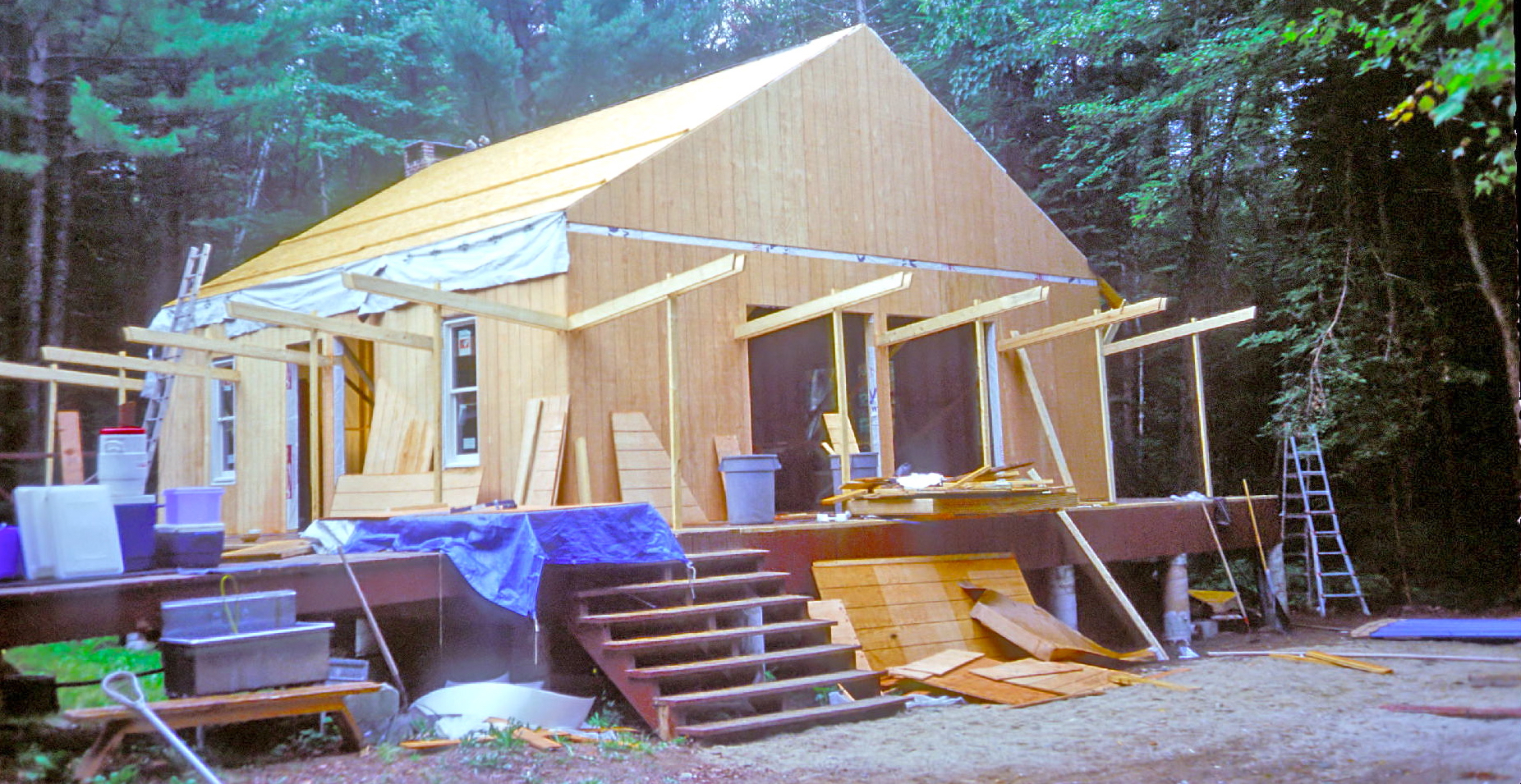
Our upper and lower Latrines were the first buildings made (spearheaded by Fran Aldrich). The Bowen’s Cabin was under construction, and Gary and I fit a double bunk into what was to be their bathroom. The Parade Ground was cleared, the Headquarters Tent where Frontier now is, a path leading to the Kitchen construction, the Kitchen Tent, the Nurse’s Tent and the two massive Mess Tents on platforms. Center Church provided us with their previous tables and chairs for dining. They were both wooden, collapsible and sturdy. The green tables and two styles of chairs served for many years yet were very hefty to move around. Much of our food came in #10 Tin Cans, which then served multiple after- uses. I never got a reliable explanation as to what happened to numbers one through ten tin cans—just #10.
Of a civilized note, Murray Johnston was credited with a metal pole outside that had painted wooden signs that pointed directions to the three main areas of the camp. The field phone system was installed as far as the waterfront. However, it proved much too slow to get the attention or get something moving quickly, so yelling became the means of communication. We yelled directions, complaints and trying to find someone. Harry modeled the technique and we followed throughout. By mid-second week, he would lose his voice and would whisper into the ear of a subordinate, who would then translate to the rest. He drew on lessons learned from Mentor Nelson Sly and used many aspects familiar from Camp Pioneer. One such was the creation of a Memorial Camp that had specific areas dedicated to significant members.
Gary and I were given missions to accomplish that first second week. For him, it was to be a Waterfront Director—of which he can take full pride in the fact that he came into the Troop the first year as a non-swimmer. His Waterfront had a respectable dock, raft and our fleet of Sailfish, Canoes and Rowboats. The crowning piece of equipment was the very distinct sounding air horn. It became a privilege to plunge the handle down and hear the loud sound resound throughout the land. It might be good to mention that this air horn had been deftly lifted from the Lake of Isles Sailing base—on permanent loan to us. For me, I got to continue to do ‘the Garbage Run’ in Harold Whiting’s black Timkin Truck from the 1950s, complete with running boards for Senior Scout helpers to hang from.
We were also sent out with the 54s to chop out of the woods our Nature Field. With sunlight able to pour into the area, ground cover, berries and bushes began to grow that served the local wildlife with the important fringe and browsing areas. This was near the beaver pond—that really was a dammed up pond for many years that provided more fringe and water for critters.
A significant quest given to us was to create the New Hampshire version of the senior Dance. Harry had made connections with Prudence Nichols, a highly respected Girl Scout Leader, who brought together troops from Newport and Sunapee. The young ladies came into camp and were given tours by the bathed and spiffed seniors, much to the glee of the uniformed scouts at retreat. The venue was the Lempster Town Hall on the opposite mountain that offered a large wooden floor dance hall and stage. At its height, ‘The Dance’ would take a crew an entire day to set up, with a sound system rivaling professional road shows, an enviable discography of music and a legend at its end with ‘Stairway to Heaven.’ In this premier production, we used Harry’s phonograph, a limited number of 45 rpm records, and decorated the hall with two colored light-bulbs. It shows how you can begin greatness, and the appeal for the Dance has stood the test of time.
It would be our second year that the Dedication of Camp Kirkham would be held. Harold Whiting (of New Hampshire) and George Caron were two examples of locals that proved very helpful for this new group of ‘Flat-landers’ in their town. In particular and for the dedication, a place was sought to rest the plaque honoring the Camp to the memory of Donald Kirkham. These two men knew of a stone being removed from a location, procured it and delivered to its spot with a ‘cherry picker.’ The plaque was attached and covered in canvas and was the capstone unveiling during the Dedication.
The road into camp was narrow and prone to erosion. The closest store was the ‘Chatterbox’ that became a staff favorite and clandestine destination of awol scouts. Harold Whiting, as Business Manager, and others almost commuted to New Hampshire in the early years to file government paperwork, start building projects and seek out new places to find needed supplies in Newport, Claremont and Sunapee. He established ties with services there, such as Lavalley’s Lumber that helped us out. In Keene resided the Scoutmaster’s favorite restaurant – the ‘Hitchin’ Post’ that had 10 cent hamburgers and fit our budget well. As we approach fifty-years at camp, we have watched these towns grow and modernize, while at the same time have seen towns like Lempster, Goshen, Unity remain the sleepy little places they always were. Of interest on our mountain was the High View Church Farm. This was a self-sustaining community based upon religion that later developed the Jolly Farmer Restaurant and other businesses.
In the first years, it took until Wednesday of the first week to get the camp fully set up. During the time there seemed to be always building projects, erosion control on the downward path and the erection of the wooden gateway to emulate that of Camp Pioneer. On Wednesday of the second week, the process to take it all down began. Families had to re-make their way back for the Saturday final Court of Honor and find parking on the narrow road.
Once all the Scouts were on their way homeward, packing up the camp turned serious. The need for labor meant the enlisting of a number of staff, many coming just for that purpose at the end. The traditional reward for the hard work done was the Party. As we had across at Lake of Isles, the work went until dark, when Steamers, Corn and Chicken were feasted upon. A great Campfire with loud singing went on for the rest of the evening. It included the Junior Staff at that time.
Sunday morning was a large breakfast and continued work until 2:00. That is when your choice of ‘Lobster or Steak’ was greatly enjoyed, final cleanup and police of the area was done and with the traditional ‘You’re All Fired’ by the Scoutmaster, staff began to trickle out.
Once the Kitchen was built, it gave a storage space that, on a priority basis, meant certain things need not be brought back to Manchester to store and be brought back again. The rather heavy grey metal bunks were the choice, which when collapsed stacked well inside. It was packed so tightly that one could only walk sideways into the Kitchen amidst the bunk stacks and other items.
Bermuda
I have always enjoyed when we tell outsiders about our Troop, that we give a pleasure trip to Bermuda as a reward for staying in the full time. That trumps a hearty hand-shake and ‘well done’ pat on the back that others culminate with. Growing up, the stories from it were rather cloaked in mystery, as whispered legends we enviously heard and looked forward to going on. At that time the destination was Miami Beach with deep-sea fishing trips, sea-worlds and hotel pools.
Beginning with the 1949 age-group in 1966, Harry acted on the drop in air-fares to other places and gave that group an Island destination out-side of the USA, which was Bermuda. The following year was our age-group and a prior meeting held that asked US to choose where we would like to go. With the ball in our court, Bermuda was quickly moved aside as there was no desire to copy the group before us. We funneled it to a tropical Island that would be outside the country (after shouting down the one suggestion to visit the Philmont Scout Ranch.) Nassau in the Bahamas became the overwhelming choice and we prepared for it. While certainly the trip is the culmination, the preparation and anticipation of going is a significant by-product. At that time, most of us had neither been outside of the USA, or ever flown on an airplane. Amazing to point out that Harry was willing, as with the Spring trips, to chart separate destinations each year so it would be our call of where to go. That adventure was a highlight of life, as we met and spent time with a Girl Scout Troop visiting (and they had to wear uniforms), lived above ourselves and bonded further as an age-group. For then and ten years after, you went before your JA year, compared to now at its climax. That trip was also a ‘one-off’ as Harry compared Bermuda to Nassau and found the former to provide the experiences he was looking in the future for. We are now fifty years into that plan and no matter your age-group or if your hotel was Harmony Hall, Stonington Beach, the Sonesta, Grotto Bay, Elbow Beach or Southampton Princess—the commonality of what for many has been ‘the best week in their lives’ stands tall.
Scoutmaster Harry Maidment
Whatever can be said about Harry is probably an understatement. This was a man focused and passionate on what he did, always in motion with energy that made him last to bed and first up. Being recognized as the youngest recipient in the council of the Silver Beaver (which he confessed he orchestrated himself) only spoke to his huge efforts in scouts. He was Guidance Counselor, Center Church Youth Leader, on Conservation Commissions and the Board of the Lutz Museum, even led the Young Republicans earlier.
He was a War Veteran with a Loomis and Yale education and background with Camp Pioneer. He walked faster, yelled louder and knew more about so many topics than the rest of us. In an era that fronted adult formality, he was ‘Harry’ instead of Mr. Maidment. He connected with his scouts, cursed creatively, knew so many songs and played multiple instruments, spoke several languages and shared his life so often with us– when he could have been successful in so many other callings. He provided a credibility with those younger so that he was approachable on any topic or question we hesitated to ask any other adults. He was the one you sought when overwhelmed with serious trouble. He could explode upon you with a poke, push, a cuff with an indictment (often including quoting of Scripture) of some wrong both of you knew you were guilty of. He had the implied confidence that your parents would not question but would support his methods. He had the rather rare ability to compartmentalize his wrath, was not prone to hold grudges or stew on your past guilts and would restore you to good status quickly. He had the arrogance to call people during their dinnertimes ‘because that is when you catch them at home’. He forged his path strewn with obstacles (‘no one else has ever ……’) when so many other courses would have been safer or easier (but without the results he was looking for). He had faith in young men and gave opportunities to lead when others would have seen them as poor risks at their age. Whatever task he charged you with, he always followed it up expecting you to have completed it, or pay the tirade. John Bowen became his closest friend, and once remarked to me ‘Like all Great Men, Harry is full of himself.’ If he took a position that might be seriously questioned, he knew if he hinted that he would resign, the opposition would melt and he would get his way. He wrote his Master’s Thesis on running a scout troop, and put into place a hierarchy that could insulate him from controversy yet still give him ultimate clout with a singular purpose. His qualities drew in an inner circle of talented men that moved his ideas forward, found solutions to problems, frustrated and sparred with him on issues and provided such a cohesive force to accomplish what the Troop has.
He did not just choose his own direction for Summer Camps. In the 1970s, he pulled Troop 25 out of District Camporee competition. He pooled together a number of disgruntled troops to form their own invitational, and for a number of years it was run on a smaller, more efficient style with Harry’s leadership stamp all over it. He shopped at A&P for Tudor Beer and made known his house was rather always open for staff. After Wednesday meetings, at his house or rotating with others, was a Staff Meeting to reflect, muse and project on a variety of topics.
At a banquet, Harry was called up and given the first ever ‘Scoutmaster’s Award’ which was for the entire northeast (US) region. When the standing ovation ended and he returned to his seat He leaned in to me and said ‘I never heard of the thing.’
His was a life that counted, and when asked about it he quoted Sir Christopher Wren. ‘If You Seek My Monument, Look Among You.’ So many of us continue as these monuments. Harry’s longevity, forty years as Scoutmaster kept his drive far past when others would have stopped. When he decided ‘I Yield to Youth’, our continued good fortune was to have it placed in the very capable arms of Paul and David. This builder of empires quietly wanted to ‘just count dominos’ and spent the remaining time as the Grandfather image. Those only knowing him at that stage need to find about the Harry we had known, the strong image of the vibrant, vigorous force that seemed everywhere and actually was.
With a Purpose
When beginning this collection of recollection, I found when focusing that the topics expanded, connected, sent me to further ponder, usually while hiking, and became a pleasing task. Linked together under an umbrella of a decade, I re-confirmed how fortunate to have been a part of these times. It became clearer in reflection what shaped us and gave the later results. We were provided a rather unique circumstance that most likely will not be repeated. It is a reference point that our continued success can draw back to with pride. What I would most like to come from this, in the 100th year of troop 25, is that others will add to this. There are so many other perspectives and experiences, not limited to the narrative above, that can spur many more chapters to share.
We have the opportunity to share the essential and the trivial, the historic and the downright entertaining. Very few places in life hold one’s attention for seven years, and offer a lifetime of continued participation. What I am personally most thankful for is the support given by my Parents and Suzanne, to have been blessed with good health, to have learned from countless mentors, both older and younger, to gain an appreciation for what has been gained and to have continued to be active throughout this time.
Dedication
In a large meaning the word ‘dedication’ is symbolic of the hundreds of leaders that serve the Troop for the decades. With a great sense of pride we can say the sustaining dedication at all levels is voluntary. On becoming Eagle Scouts in recent years, they have the opportunity to award a ‘Mentor Pin’ at the ceremony that defines for the Eagle Scout that person having the most positive effect on them. I treasure the times I have been chosen yet humbly realize I am only one of numerous people deserving recognition.
I want to now use this idea, that for the decade described, my Mentor Pins would go to: John Bowen, Harold Whiting and Harry Maidment. I cannot narrow it further as these men took an interest in me and provided the guidance, knowledge and inspiration for which I am forever grateful.
Thank You, sincerely, for listening.
0 comments